 |
|||||
|
|||||
| Preview of Stamps Catalogue: VOLUME 1 |
|
|||||
|
|||||
| Preview of Stamps Catalogue: VOLUME 1 |
Return To Catalogue - Issues of 1853-1859 - British Guiana 1860 - British Guiana 1862 - British Guiana 1863 - Issues of 1876-1888 - Issues of 1889-1920 - Miscellaneous
Note: on my website many of the
pictures can not be seen! They are of course present in the catalogue;
contact me if you want to purchase it.
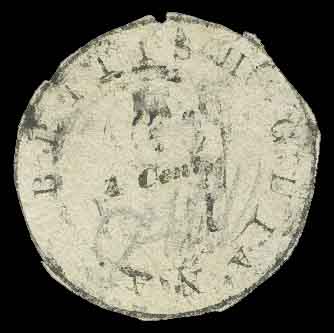

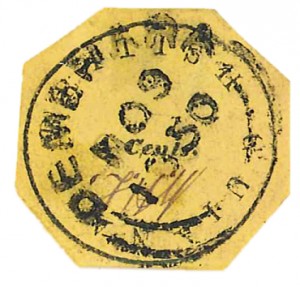
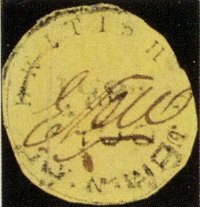
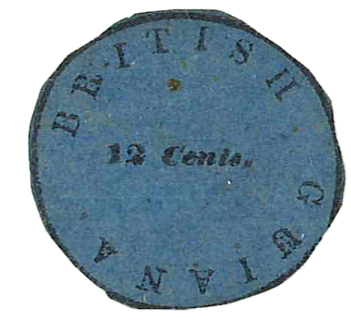
(Genuine stamps )
  2 c black on red
  4 c black on yellow
  8 c black on green
  12 c black on blue
These stamps are commonly known under the name 'cottonreels' or 'cotton spool stamps'. All these stamps are extremely rare. The 2 c is the rarest (it was only discovered in 1877! Ten of such stamps are known to exits, among them 3 pairs, no uncancelled 2 c stamps are known). A signature of the postmaster can be found on all used stamps (to prevent fraud). The following signatures seems to exists 'E.T.E.D.' (colonial postmaster Dalton); 'E.D.W.' (postal employee Wight); 'J.B.S.' (postal employee Smith), 'H.A.K.' (postmaster Killikelly from Georgetown) and 'W.H.L' (letter carrier Lortimer).
Signature 'E.D.W.'
Signature 'W.H.L'.
Signature 'J.B.S.'
Forgeries, examples:
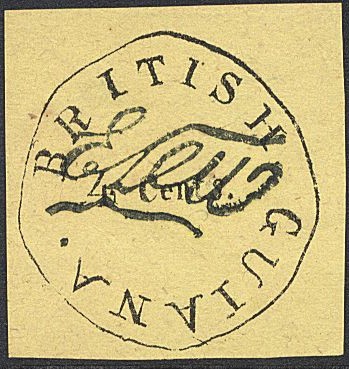
forgeries, note the imperfect shape of the circle. Some of them
have a printed "E. D. W." signature
Slighlty different forgery type.
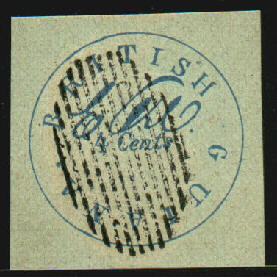
Some more forgeries, even with wrong colours! I've seen a 8 c
forgery of this type in a Fournier
Album of Philatelic Forgeries (with "FAUX" overprint as
usual). This indicates that Fournier sold this type of forgery.
This forgery type is also illustrated in a Schaubek Album. Note
the wide variety of cancels (among them "B02" from
Suez).
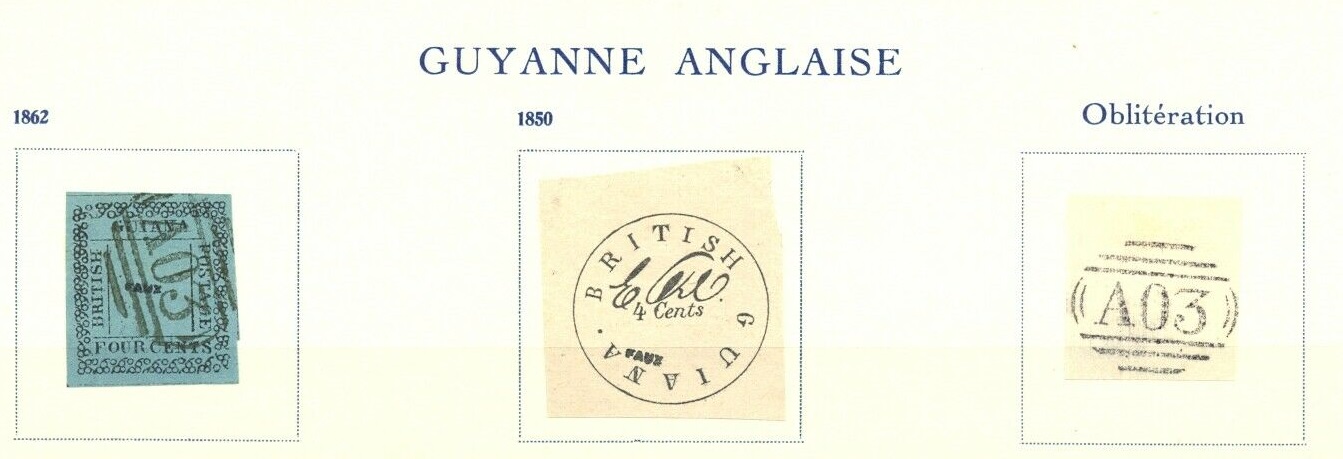
Page from a Fournier Album of Philatelic Forgeries with a 4 c of
this type..
Other forgery
Yet another forgery.
(some other forgeries)
And another forgery
Images reproduced with permission from: http://www.sandafayre.com
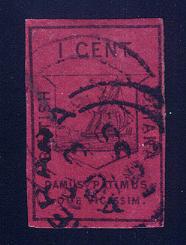
Genuine, with typical 'DEMERARA' cancel)\
(Certified genuine)
(Most likely genuine)
(Probably forgeries)
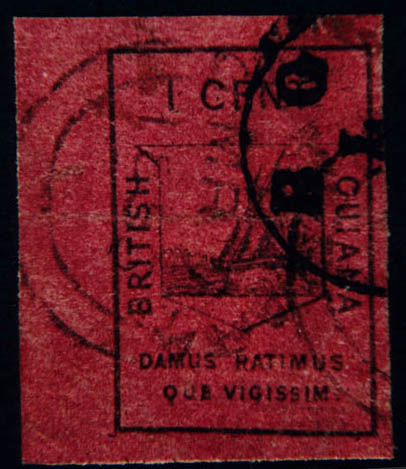
  1 c black on red
  4 c black on blue
Value of the stamps |
|||
vc = very common c = common * = not so common ** = uncommon |
*** = very uncommon R = rare RR = very rare RRR = extremely rare |
||
| Value | Unused | Used | Remarks |
| 1 c | RRR | RRR | |
| 4 c | RRR | RRR | |
Forgeries, examples (by the way I think the above stamps could be forged as well):
(Reduced sizes)
Perforated (perforation 12 1/2) reprints exist:
(perforated reprints or forgeries?)
I don't know if the above perforated stamps are the reprints, they are probably just forgeries. Some reprints exist with the perforation cut off, pretending to be genuine stamps.
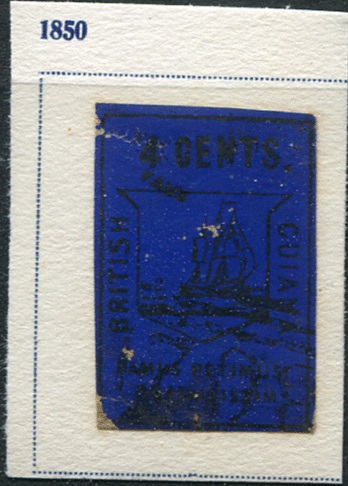
A forgery from the Fournier Album of forgeries. "C" of
"CENTS" too narrow.
The forger Peter Winter also has made forgeries of these stamps. They were produced in the 1980's. I suspect the next stamps to be such forgeries:
Peter Winter forgeries?
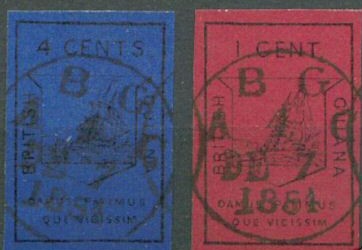
(Winter forgeries with "B G A C 4 DE 7 1854" cancel)
Letter adressed to 'The Lord Bishop of Guiana Georgetown'. The
letter was also forged by Peter Winter.
Forgeries with the 'Q' of 'QUE' different, the tail of this
letter is pointing too much to the right. The 1 c was also found
in the Fournier Album of Philatelic forgeries.
Primitive forgery with double framelines.
Another forgery with a bogus ring cancel.
Another primitive forgery.
For stamps of British Guiana issued after 1852 click here.
