![]() |
|||||
|
|||||
| Preview of Stamps Catalogue CD : VOLUME 1 |
Return To Catalogue - Great Britain
Note: on my website many of the pictures can not be seen! They are of course present in the cd's;
contact me if you want to purchase them:
.
With thanks to David Stirling (Scotland) for his help with this page. He has put up a site to distinguish the forgeries of these stamps, see Cinderella site by David M. Stirling.
More information about this area can be found in the following book: "Great Britain: The Stamps of the Circular Delivery Companies and their Forgeries", isued by the Cinderella Stamp Club, Handbook No 7, By C G Harman, London: The Cinderella Stamp Club and Frank Godden Ltd. 1990.
Other book: 'Farthing Delivery, a Right for Cheaper Postage' by Donald S. Patton, London, Lowe & Brydon (printers) Ltd.
These companies were established by James Nixon Brydone or his son Robert. They exist for nine cities of the United Kingdom. However, they were never put into use because the Post Office sued them. There are several forgeries of these stamps.

(Glasgow genuine stamps)
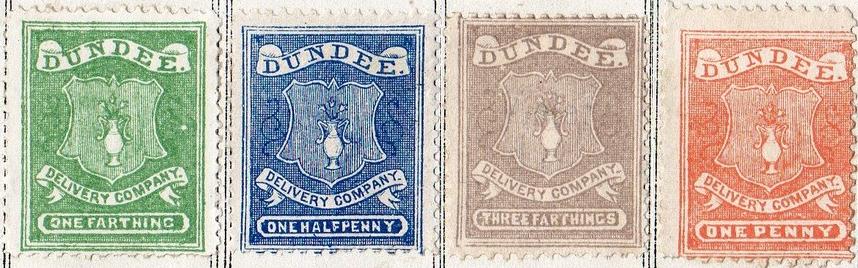
(Other cities, genuine stamps)
According to David Stirling in his website: http://www.geocities.com/david_m_stirling/Circular.html :
"The Circular Delivery Company Limited was the last of the Brydone Companies and was formed and registered on 22 February, 1868. New stamps were prepared for the seven cities which had previosly had stamps, and two new cities. The stamps were printed in sheets of 81 (9X9) having nine rows of stamps, each row being for a different city. There were four values only, farthing, green, halfpenny, blue, three farthings, brown, and one penny, pale scarlet. A vertical column from each sheet of values would thus produce a complete set of the four values from all nine cities. The Cities, in their oder in the sheet, were Dundee, Manchester, Glasgow, Liverpool, Aberdeen, Birmingham, London, Metropolitan and Edinburgh & Leith. Only one printing was made of these stamps, though they were later extensively forged, indeed the first forgery was noted by Dr Magnus in "Le Timbrophile" in October, 1868.
Following prosecution against them, the Circular Delivery Company Limited went out of business on 2 June, 1869
The original stamps had the lettrers T N D and C inserted into the four corners of the design. There is no evidence available to show that these stamps ever saw actual usage, and it is more likely that they were produced for sale to collectors, which is exactly what happened. They are not uncommon, although they are far outnumbered by supplies of some of the forgery types. Copies with a blue pencil line across them are from the Licoln stock, he being under the impression that it was illegal to sell them unused.
The first forgery appeared in 1868 and is dangerous as it also has the letters in the corners. It is only known in imperforate condition."
So the only genuine stamps can be: 1 f green, 1/2 p blue, 3 f brown and 1 p red (scarlet). David also gives a table to distinguish the most dangerous first forgeries from the genuine stamps:
| City | 1 f | 1/2 p | 3 f | 1 p |
| Aberdeen genuine | Coloured dot in left leg of 'H' of 'FARTHING' | Value reads 'ONE HALFPENNY' | 'FARTHINGS' evenly spaced | Coloured dot in 'E' of 'ONE' |
| Aberdeen forged | No coloured dot in 'H' | Value reads 'HALF PENNY' | 'HIN' of 'FARTHINGS' crushed together | No coloured dot in 'E' of 'ONE' |
| Birmingham genuine | Letters of 'ONE FARTHING' equally spaced | Value reads 'ONE HALFPENNY' | 'THREE FARTHINGS' one word evenly spaced | Three dots in white frame over 'N' of 'ONE' |
| Birmingham forged | Letter of 'ONE' smaller than 'FARTHING' | Value reads 'HALF PENNY' | Space between 'THREE' and 'FARTHINGS' | No dots in white frame over 'N' of 'ONE' |
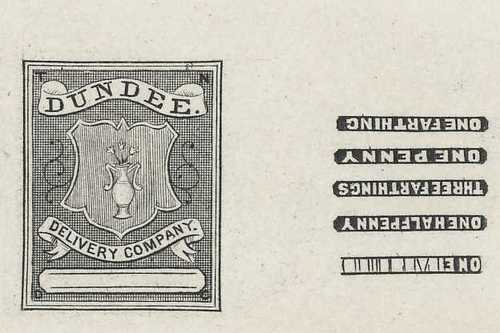
| Dundee genuine | 'ONE FARTHING' thinn and small, 'O' broken at left | Value reads 'ONE HALFPENNY' | Normal 'H' and well formed 'G' in 'FARTHINGS' | Value tablet broader. 'ONE PENNY' tallere. Small space between 'Y' and tablet end. |
| Dundee forged | 'ONE FARTHING' tall and thick, narrow 'O' and broad 'G' | Value reads 'HALF PENNY' | Left lower limb of 'H' of 'FARTHINGS' missing and 'G' is deformed | Value tablet narrow, and 'ONE PENNY' shorter. Space between 'Y' and tablet end. |
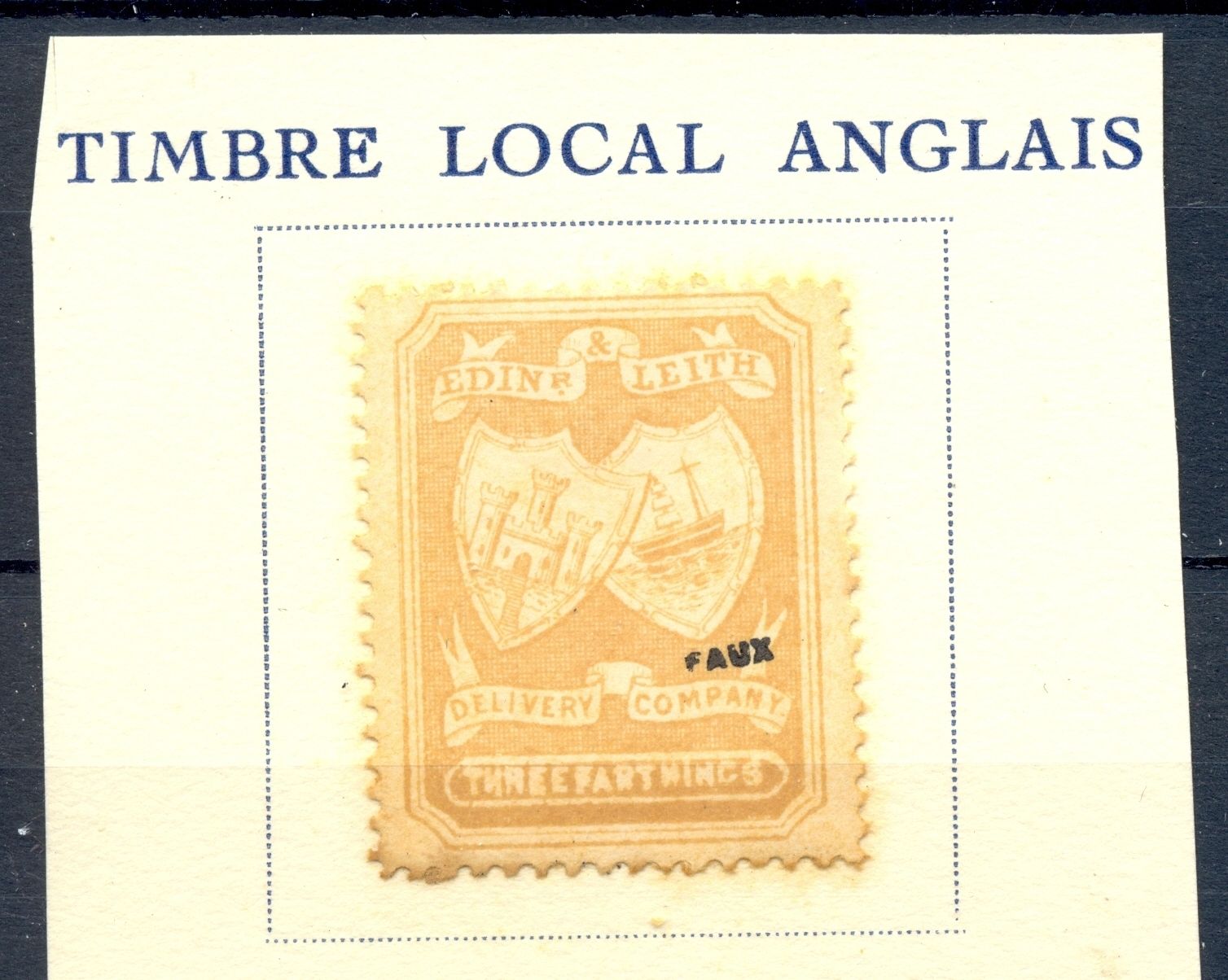
| Edin. Leith genuine | Mark to left of 'O' of 'ONE' bracket shaped | Coloured flaw in upright of 'E' of 'PENNY' | Coloured line under 'RTHINGS' | Coloured bracket shape to left of 'O' of 'ONE' |
| Edin. Leith forgery | No bracket shaped mark | No coloured flaw | No coloured line | No coloured bracket shape |
| Glasgow genuine | 'ONE FARTHING' small and thin. 'O' broken at left | 'H' of 'HALF' is well shaped | Letters of 'THREE FARTHINGS' well formed and spaced. A line divides upper value frame. | 'ONE PENNY' letters shorter. Colour line in upper value tablet |
| Glasgow forged | 'ONE FARTHING' tall and thick. Narrow 'O' and broad 'G' | 'H' of 'HALF' is like an inverted 'N' | Letters of 'THREE FARTHINGS' badly shaped. 'HR' and 'HIN' compressed. | Letters of 'ONE PENNY' tall and thick |
| Liverpool genuine | Well formed crossbar to 'H' of 'FARTHING', two white dots left of 'O' of 'ONE' | Value reads 'ONE HALFPENNY' | Letters better spaced | White flaw over space between 'ONE' and 'PENNY' |
| Liverpool forged | Cross bar of 'H' hardly visible | Value reads 'HALF PENNY' | 'THREE FARTHINGS' badly spaced | No white flaw over space between 'ONE' and 'PENNY' |
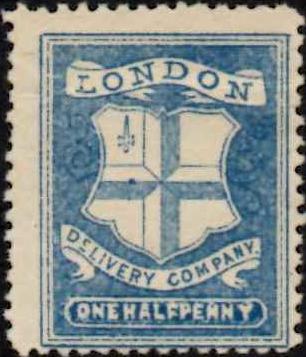
| London genuine | Two vertical white lines to right of 'G' of 'FARTHING' | Value reads 'ONE HALFPENNY' | White upper frame line over 'THREE' | 'ONE PENNY' in taller figures |
| London forged | No white lines to right of 'G' of 'FARTHING' | Value reads 'HALF PENNY' | No white frame line over 'THREE' | 'ONE PENNY' in short figures |
| Manchester genuine | Coloured stroke in left top of 'T' in 'FARTHING' | Value reads 'ONE HALFPENNY' | 'THREE' and 'FARTHINGS' one word | Large space between letters and value tablet |
| Manchester forged | No stroke. Larger space between 'G' and frame | Value reads 'HALF PENNY' | Space between 'THREE' and 'FARTHINGS' | 'ONE PENNY' almost touches frame |
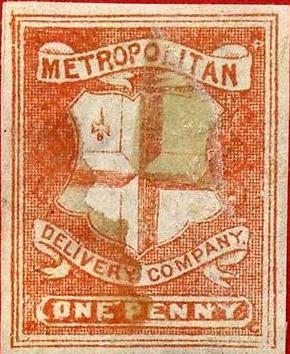
| Metropolitan genuine | 'ONE FARTHING' shorter and better spaced | Stem of 'Y' of 'DELIVERY' missing | 'P' of 'METROPOLITAN' slopes to the left | Crescent shaped mark to right of 'O' of 'ONE' |
| Metropolitan forged | 'ONE FARTHING' taller and badly spaced | With stem of 'Y' | 'P' of 'METROPOLITAN' slopes to the right | No white mark to the right of 'O' of 'ONE' |
David Stirling further says:
The genuine stamps are also encountered in imperforate condition but can be distinguished using the above tests. The other forgeries of the Circular Delivery Company Limited's stamps do not contain the letters TNDC. The producers also created additional values above 1d. These are, of course, totally bogus.
The second forgery of these stamps has been attributed by an early source to Edwin Healy. These are nicely printed by lithography, in the same sheet formation as the genuine, but lack the letters TNDC in the corners. There are six values for each of the nine locations.
Farthing green, halfpenny blue, three farthings buff, one penny vermillion, three pence yellow and six pence carmine. The last two values are totally bogus. The distance between the horizontal rows of stamps is 2.5 mm. and this is less than the succeeding forgeries. The colours are generally bright, unlike the third forgery, where they are rather flat. This forgery is perforated 11.5.
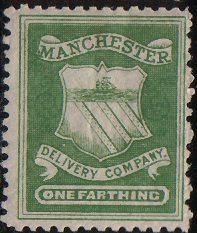
Other values for other cities exists, examples in reduced sizes:

(Reduced sizes, could be all forgeries)
I presume that all the other values I've seen (listed below) are forgeries.

1 f lilac 1/2 p blue 'ONE HALFPENNY' 1/2 p blue 'HALF PENNY' 1 p blue 1 p green 2 p brown 3 p lilac 3 p yellow 4 p red 6 p red
1 f green 1 p blue 1 p green 2 p brown 3 p lilac 3 p yellow 6 p red


(Forgery)
1 f green 3 f orange 1/2 p blue
The following values are probably bogus issues?


Edinburgh-Leith 1/2 p green 1/2 p blue 1 p green 2 p brown 3 p lilac 3 p yellow 6 p red


1/2 p blue 1 p blue 1 p green 2 p brown 3 p lilac 3 p yellow 6 p red

(Forgery!)

1 f blue 1/2 p blue 1 p green 2 p brown 3 p lilac 3 p yellow

(Forgery!)
3 f brown 1/2 p blue 1 p blue


1 f green 1/2 p blue 1 p blue 1 p green 2 p brown 3 p lilac 3 p yellow
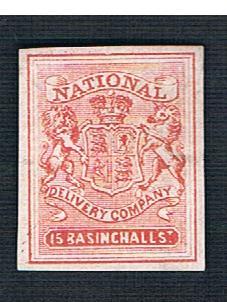
(Forgery!)
David Stirling writes:
This Company was one of the farthing circular delivery companies formed by Robert Brydon of Edinburgh, and emulating the system and pricing of the Glasgow Parcel Delivery Company which, for some twenty years previous, had been undertaking the same task at the same competitive prices. Although other writers have hailed this form of cheaper delivery as an innovation of Brydone's, such was not really the case. The stamps appeared in July, 1867, but there is no conclusive evidence that they were ever put into actual use. The stamps were lithographed in sheets of 130, 10 across by 13 down. The farthing value is the scarcest of the two stamps. They were manufactured by James Edward Nixon Brydone, Printer and Lithographer, of Edinburgh, the father of Robert Brydone. His printing establishment was at 12 Elder Street.

(Reduced sizes)
1 f (=1/4 p) orange-brown. 1/2 p blue (shades).
The farthing value is normally more heavily printed than the halfpenny stamp and many of the stamps, being smudged and badly printed, were destroyed. This accounts for its relative scarcity. No used or imperforate specimens, of either stamp, have been noted.
Are these forgeries?:


David Stirling writes:
The stamps for this company appeared in February 1867 and were printed by James Edward Nixon Brydone. Two values exist, imperforated or pin-perforated, in sheets of 66 (11 horizontally and 6 vertically) on laid paper.

1/4 p black on white laid paper, pin-perforated, and variety imperforated in between, reduced sizes

(reduced sizes)
1 f (=1/4 p) black (intense black to grey black)
(imperforated or perforated)
1/2 p red
Dvaid Stirling writes:
The Edinburgh & Leith Circular Delivery Company was the first of Robert Brydone's circular delivery companies and, at first, shared premises with Edinburgh & Leith Parcel Delivery Company, at 12 St Andrew Square. Despite what may have been said by other writers, the idea of circular delivery was not novel and, indeed, had been practised by the Glasgow Parcels Delivery Company since 1846. Both Edinburgh Companies had been formed towards the end of July, 1865. Robert Brydone was one of the two sons of James Edward Nixon Brydone, Publisher, Printer and Lithographer of 17 Hanover Street, Edinburgh, whose printing presses operated from 12 Elder Street, Edinburgh.
Parcels wagons had been running for many years between Edinburgh and Leith, and the parcels service was no innovation. The Circular Delivery Company was, however, controversial in nature being aimed at a large slice of the GPO's revenue and was destined, eventually, to attract the jaundiced attention of the Postal Authorities, even though Brydone had sought legal advice before taking up the venture.
The Company immediately issued stamps, and these were chronicled in Moens' "Le Timbre Poste" for December, 1865. Local stamps were not novelties in Scotland as an issue had taken place as early as 1811, when a Scottish Shipping Company issued their own packet stamps. However, the stamps of the Edinburgh & Leith Company chanced on the scene when philately was in its first bloom and attracted attention all over the country. W. S. Lincoln eventually held a fine stock of them but defaced them by cancelling them with a blue crayon. The stamps were lithographed by James Edward Nixon Brydone from designs made up by George Oliver, engraver and die sinker, of Edinburgh.

1/4 p green, rouletted 7.
1/4 p green, rouletted 7, imperforate vertically between.
1/4 p green, perforated 12.
1/4 p green, perforated 12, imperforate at top and doubly
perforated at foot.
1/4 p slate, rouletted 7.
1/4 p slate, rouletted 7, imperforate vertically between.
1/4 p grey, imperforate. 1/4 p pearl grey, imperforate. 1/4 p blue-grey, imperforate. 1/4 p greenish-grey (shades), imperforate. 1/4 p greenish-grey, perforated 11 3/4 1/4 p greenish-grey, pin-perforated 10 1/2. 1/4 p greenish-grey, rouletted 7. 1/4 p mauve (shades), imperforate. 1/4 p grey-lilac, imperforate. 1/4 p grey-lilac on ribbed paper, imperforate.

(Reduced sizes)

1/4 p (1 farthing) grey-lilac, pin-perforated 10. 1/4 p grey-lilac, imperforate. 1/4 p reddish-lilac, perforated 10. 1/4 p reddish-lilac, imperforate. 1/4 p mauve, perforated 10. 1/4 p mauve, imperforate. 1/2 p green, perforated 10. 1/2 p green, imperforate. 1/2 p green, perforated 10, imperforate between vertically.
Towards the end of 1866, Robert Brydone became bankrupt and the Company was taken over by his father James, who moved the Company to his printing works at 12 Elder Street. A new issue of stamps was made from this address, in 1867, bearing the address on the tablet formerly carrying the value (see next issue).


(Reduced sizes)
(1/4 p) black on lemon, rouletted 7 to 7 1/2. (1/4 p) black on lemon, pin-perforated 7 by rouletted 7 1/2. (1/4 p) black on lemon, imperforate. (1/4 p) red-brown (shades), imperforate. (1/4 p) red-brown (shades), rouletted 7 1/2. (1/4 p) red-lilac, imperforate. (1/4 p) red-lilac, rouletted 7 1/2.
Forgeries of the above series of stamps exist, but are extremely uncommon and may be said to be scarcer by many times than the originals. Most are crudely lithographed, but a typeset forgery of the 1866 issue has been encountered.
Forgery 1. Forgery of the 1866 issue. The background to the castle in the first shield is lined. The "M" of "COMPANY" is like an "N". The workmanship is crude, the value is in sans-seriph type and the fakes have only been seen as imperforate singles.
1/4 p green, imperforate.
Forgery 2. This is also an imitation of the 1866 issue. Apart from being typeset, the forgery is easily identified as the value tablet is too high up the stamp. This fake is also scarce, indeed rare, and has been seen on thin white and thicker cream paper, rouletted 13.

1/4 p green on thin white, imperforate. 1/4 p green on thin white, rouletted 13. 1/4 p green on thick cream, rouletted 13.
Forgery 3. This forgery has the lettering of "EDINR & LEITH" in larger type than the original and the value is in sans-seriph type. It is normally found cancelled with parallel bars, in black.
1/4 p grey-blue on white, imperforate.
Used copies of the genuine stamps are extremely rare, copies cancelled with the Company's monogrammed cancellation being most desirable. On cover, they are class one rarities. In 1939, 12 Elder Street (and adjoining buildings) was demolished to make way for the new Omnibus Station of the Scottish Motor Traction Company Limited (who also issued parcels stamps!). Due to the war, however, and afterwards, by difficulties with planning permission, the project did not reach fruition until April 5th, 1957, when the official opening of the new Bus Station took place. And to crown it all, the last occupants of 12 Elder Street were David Short & Sons.....Printers!
David Stirling writes again:
This Company was formed, by Robert Brydone, towards the end of July, 1865 and issued its first stamp in August of that year. This was a yellow label, undenominated, in the design of Brydone's immediately succeeding Circular Delivery stamps. The design was by George Oliver, of Edinburgh. The stamp was chronicled in Moens "Le Timbre Poste" and, although these were designed for use on parcels, some were used on circulars until the supply of Circular Delivery Company stamps arrived. In April, 1866, a second design appeared depicting a parcels wagon being driven along at a spanking pace. This latter design was forged on at least two occasions, one of the forgeries being by our old friend, Samuel Allan Taylor of Boston.
The Edinburgh & Leith Circular Delivery Company was, at first, based at the same address, 12 St Andrew Square, but, on Robert Brydone's bankruptcy, his father James took over the Circular Delivery Company and removed it to his printing works at 12 Elder Street.
Cancellation of the stamps on parcels was usually effected with a pencil or crayon. W. S. Lincoln, the stamp dealer, cancelled a stock of mint copies, in the mistaken belief that it would be illegal to sell them in their mint state. This was after the Circular Delivery Companies' prosecutions, in 1869. I have been unable to trace any of the Company's activities after the year 1866.


(Reduced size)
(2 p) green, rouletted 7. (2 p) green, imperforate. (2 p) yellow, rouletted 7. (2 p) yellow, rouletted 7, double roulette to left. (2 p) yellow, rouletted 7, double roulette to right. (2 p) yellow, rouletted 7, double roulette at top. (2 p) yellow, rouletted 7, double roulette at bottom. (2 p) yellow, imperforate. (2 p) yellow ochre, rouletted 7. (2 p) yellow ochre, rouletted 7, double roulette to left. (2 p) yellow ochre, rouletted 7, double roulette to right. (2 p) yellow ochre, rouletted 7, double roulette at top. (2 p) yellow ochre, rouletted 7, double roulette at bottom. (2 p) yellow ochre, imperforate. (3 p) red, rouletted 7. (3 p) red, imperforate. (3 p) deep maroon, imperforate.

2 p orange, rouletted 7. 2 p orange, pin-perforated 11 1/2. 2 p orange, imperforate. 2 p orange-yellow, rouletted 7. 2 p orange-yellow, pin-perforated 11 1/2. 2 p orange-yellow, imperforate. 3 p brick red, rouletted 7. 3 p brick red, pin-perforated 11 1/2. 3 p brick red, imperforate. 3 p salmon, pin-perforated 11 1/2. 3 p salmon, imperforate.
Forgeries are known of the 1866 series, but are easily recognised. They are much scarcer than the issued stamps.
1st Forgery. This simulates the 3 p brick-red of the previous issue, and also appears in the bogus colour of yellow. It is more finely printed and is typeset. It is easily identified by there being twice as much shading beneath the parcels cart as on the genuine. Some of the copies are on very white paper, but copies have been seen on the same type of paper as the originals and are very dangerous.

(First forgery)
3 p brick-red, rouletted 3 p brick-red, imperforate. 3 p yellow, imperforate.
2nd Forgery. Very similar to the first forgery, but the ship ornament in the lower left corner has its masts joined together.

(Second forgery)
3 p brick-red, rouletted. 3 p brick-red, imperforate.
3rd Forgery. This is a Taylor production. I have only noted this in the bogus colours of blue and of mauve. It most likely exists in other colours. It only exists in imperforate condition and an easy test is the shading under the parcels cart which, unlike in the genuine, fills the lower half of the lozenge.
3 p blue, imperforate. 3 p mauve, imperforate.
David Stirling writes:
This Edinburgh Company first was noted as a stamp-issuer in 1866, when a small blue stamp of farthing denomination was brought into use. The firm had opened a parcels and circular delivery office, in early 1866, at 10 Carlton Street. The stamps appeared in two sizes, either 23.5mm. or 25.5mm. wide. These stamps were lithographed se-tenant in the sheet, which consisted of 72 stamps (8 across X 9 down). There were, therefore, 36 of each type in the sheet. The stamps were imperforate.
The Clarks were no newcomers to the parcels delivery service, having had experience of parcels and goods delivery between Edinburgh and Leith for many years. George Clark, grandfather of the proprietor, was operating one of the daily Leith Parcels Wagons in 1829.
The stamps were of no stated denomination but sold at 3d per dozen. They were lithographed by Robert Clark, Stationer, engraver and lithographer at his shop in 15 Elder Street. Robert Clark lived at 26 Dublin Street in 1866, moving to 13 Leopold Place, in 1867, and also operated the delivery service. Cancellation was by a heavy black score with indelible pencil or crayon, not to be confused with the straight blue pencil cancel applied by W. S. Lincoln to copies he sold. This was in the mistaken belief that it was illegal to sell local stamps of this type uncancelled. Only two undoubtedly genuinely used copies have been seen by me (David Stirling). Forgeries are unknown.

blue (2 sizes)
![]() |
|||||
|
|||||
| Preview of Stamps Catalogue CD : VOLUME 1 |