 |
|||||
|
|||||
| Preview of Stamps Catalogue: VOLUME 1 |
|
|||||
|
|||||
| Preview of Stamps Catalogue: VOLUME 1 |
Return To Catalogue - Germany overview
Note: on my website many of the
pictures can not be seen! They are of course present in the catalogue;
contact me if you want to purchase it.

  5 p green
  10 p brown
Example: Alsener Kreisbahnen Express:
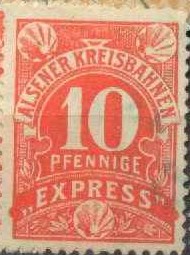
Many more railway stamps exist in Germany. For more examples, click here.
Labels with picture of the lost territory, such as Danzig, Schleswig or Elsass, in black, center of the stamp in colour:
(reduced sizes)
Besides the above labels, I have seen: 'Oberschlesien', 'Posen' and 'Eupen-Malmedy'.
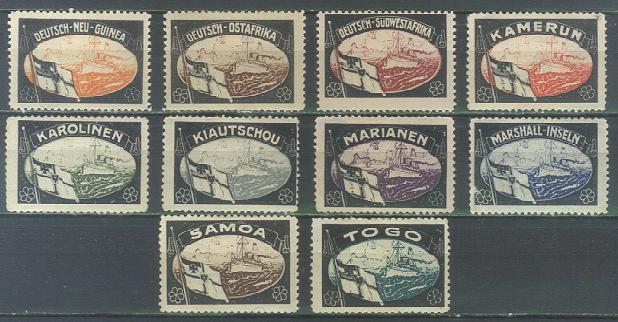
(Lost colonies, 'Deutsch-Neu-Guinea, Deutsch-Ostafrika, etc,
reduced sizes)
After the first world war, labels were issued to commemorate the lost territories and colonies.
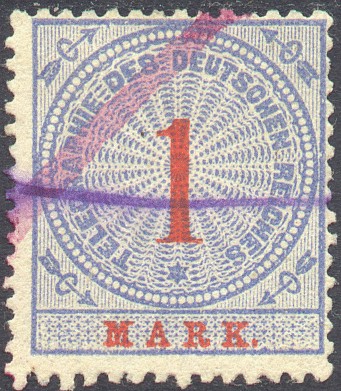
The following values exist:
Value in 'groschen' (1873)
  1/2 g blue
  1 1/4 g blue
  2 1/2 g blue
  4 g blue
  5 g blue
  8 g blue
  10 g blue
  30 g blue
(all stamps in blue, values in black)

Value in 'Pfennige' (1875)
  3 p blue
  5 p blue
  10 p blue
  25 p blue
  40 p blue
  50 p blue
  80 p blue
(stamps in blue, value in black)

Value in 'Mark'
  1 M blue
  2 M blue
  3 M blue
(stamps in blue, values in red)
In Le Postillon Revue Philatelique of March 1920 on page 507, a partial forgery is described of the rare 3 p blue stamp. It was made by chemically removing the red parts of a 1 M blue stamp and then reprinting "3 PFENNIGE" on it.
Similar stamps exist for the North German Confederation: inscription "NORDDEUTSCHE BUNDES TELEGRAPHIE".
Telegraph label:
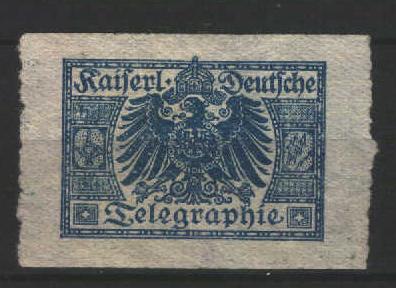
(Reduced sizes, note that 'Kaiserl' is removed from the first
stamp)
Inscription 'Gehangt am 8. Aug. 1944' (hanged at the 8th of August 1944).
(Another war propaganda forgery with the image of Himmler)
Many seals were issued in Germany. Some typical examples:
I've often seen the next label with inscription "SPENDE FUR DEN OSTMARKENSCHATZ":
Inscription "VLISSINGER POST ROUTE KONTINENT ENGLAND" from Vlissingen (the Netherlands) to Great Britain, sailor with map.
(Reduced size)
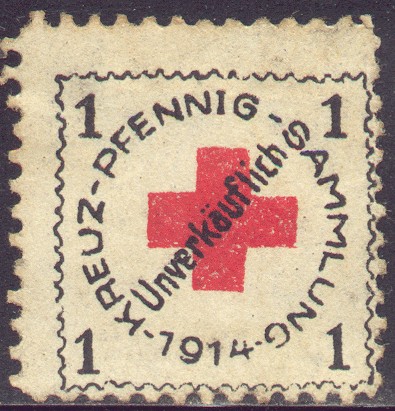
I have seen other values: 1) the same as shown here but with the '1' removed from the corners and overprinted with a large '2', 2) a 5 p in a different design (red and black), 3) a 10 p in again a different design (red and black); they all have the inscription 'KREUZ SAMMLUNG 1914'.
(Here a 10 p on a letter to the 'International comittee of the
red cross; agency of prisoners of war' in Geneva with cancel
'DILLENBURG 7 3 15' applied next to the label)
With inscription 'Wertbrief Beforderung Deutschland - Amerika'
  5 M green
  10 M red
  15 M grey
  20 M blue
  25 M brown
  50 M lilac

Without inscription 'Wertbrief Beforderung Deutschland - Amerika'
  5 M green
  10 M red
  15 M grey
  20 M blue
  25 M brown
  50 M lilac
  75 M black on silver
  100 M violet on gold
Imperforate forgery of such a stamp, with the inscription 'FAUX' in the right bottom corner
Reduced size
A modern 'reprint' of the 50 M red (perforated) on a minisheet was made in 1976 for the NAPOSTA exhibition, the minisheet has the inscription 'Wertbrief-Beforderung Deutschland - Amerka 1916 NORDPOSTA 1976 Die USA zu Gast in Hamburg' in green.
