 |
|||||
|
|||||
| Preview of Stamps Catalogue: VOLUME 1 |
|
|||||
|
|||||
| Preview of Stamps Catalogue: VOLUME 1 |
Return To Catalogue - Germany 1870-1874 issues - Germany 1889-1899 issues - Germany overview
Note: on my website many of the
pictures can not be seen! They are of course present in the catalogue;
contact me if you want to purchase it.
Number, inscription in 'pfennige' (with final e), issued 1 January 1875
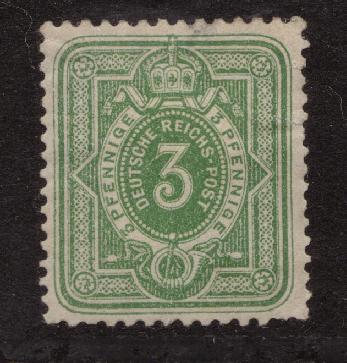
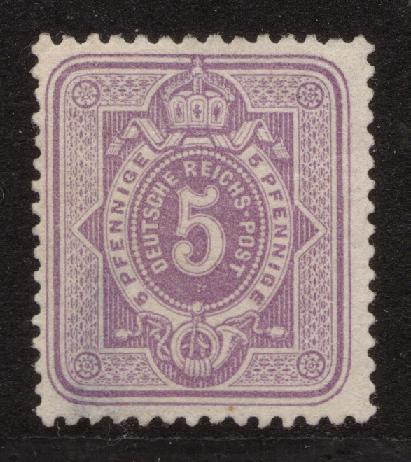
  3 p green
  5 p lilac

Number, inscription in 'pfennig' (1880)

  3 p green
  5 p lilac

Eagle, inscription in 'pfennige' (with final e), issued 1 January 1875

  10 p red
  20 p blue
  25 p brown
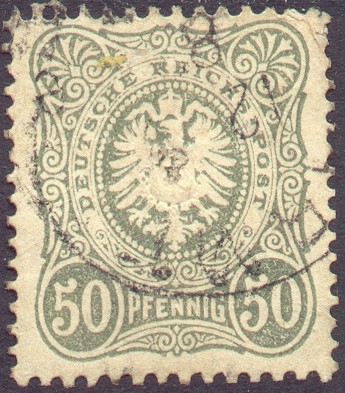
  50 p grey (also greenish grey)

Eagle, inscription in 'pfennig' (1880)
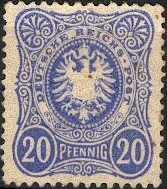
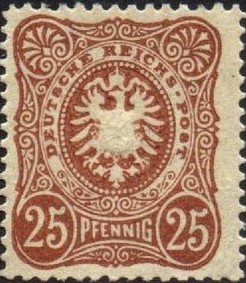
  10 p red
  20 p blue
  25 p brown
  50 p grey
These stamps have perforation 13 1/2 x 14 1/2.
Value of the stamps |
|||
vc = very common c = common * = not so common ** = uncommon |
*** = very uncommon R = rare RR = very rare RRR = extremely rare |
||
| Value | Unused | Used | Remarks |
| 3 p | *** | * | with 'e' |
| 3 p | * | c | without 'e' |
| 5 p | *** | c | with 'e' |
| 5 p | * | c | without 'e' |
| 10 p | *** | c | with 'e' |
| 10 p | ** | vc | without 'e', issued March 1880 |
| 20 p | RR | c | with 'e' |
| 20 p | ** | vc | without 'e' |
| 25 p | RR | * | with 'e' |
| 25 p | ** | c | without 'e' |
| 50 p | RR | * | with 'e' |
| 50 p | ** | c | without 'e' |
Strassburg forgery (Straßburger Fälschung):
Some very rare postal forgeries were made of the 10 p in 1885 in Strassburg, the so-called 'Straßburger Fälschung'. A picture of a block of 12 of these forgeries can be found at: http://www.museumsstiftung.de. If anybody posesses a better picture, please contact me!
Barmer forgery (Barmer Fälschung)
Barmer forgeries together with a genuine stamp (most right
image); image of uncancelled forgery obtained from
http://www.museumsstiftung.de. The left stamps have a
'Langerfeld' cancel. The ornaments at the sides are slightly
different.
Towards the end of 1882 a lithographer in Barmen, Mr. Friedrich Wilhelm Riechers forged the 50 p value. 300000 stamps were printed in rows of at most 10 stamps and 140000 stamps were used according to http://www.museumsstiftung.de. This forgery is very deceptive.
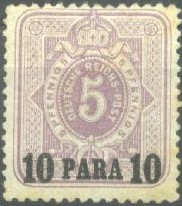
Surcharged stamps ('PARA' or 'PIASTER') were used in Turkey, for more information click here:
'Imperforated stamps' are cuts from envelopes, examples:
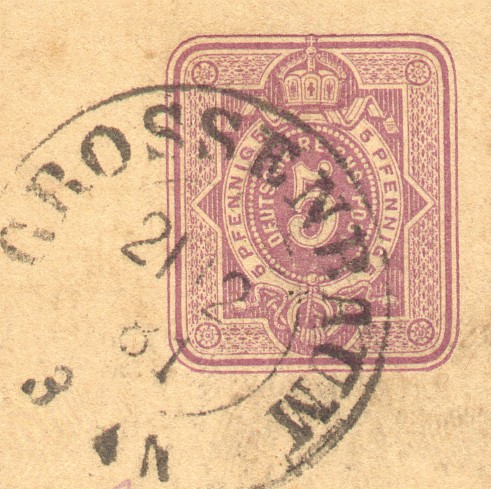
(Tube mail 'Rohrpost': 30 p blue, issued in 1876)
A 25 p brown tube mail postcard, note the different '5' in '25'
as compared to the postage stamps
Cancels, examples:
(Proof, 50 p green, 'REICHSPOST' at both sides)
Die Postfälschungen des Dt. Kaiserreiches, Jäschke-Lantelme, (postal forgeries of the German empire, in German), 120 pages
Stamps - Briefmarken - Timbres-Poste
