![]() |
|||||
|
|||||
| Preview of Stamps Catalogue CD : VOLUME 1 |
Return To Catalogue - Newfoundland 1897-1920 - Canada - Forgeries of the first issues - Postal stationery and Fiscal stamps
Note: on my website many of the pictures can not be seen! They are of course present in the cd's;
contact me if you want to purchase them:
.
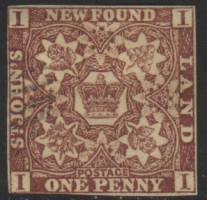
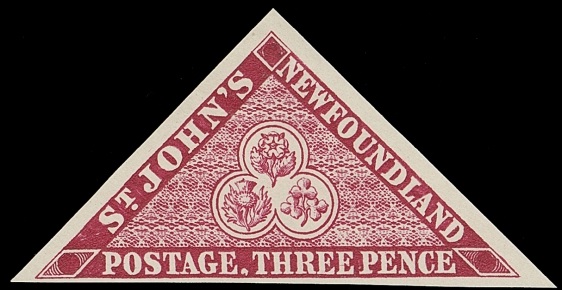
1 p brown 5 p brown

Triangular stamp
Triangle 3 p green
Value of the stamps | |||
vc = very common c = common * = not so common ** = uncommon | *** = very uncommon R = rare RR = very rare RRR = extremely rare | ||
| Value | Unused | Used | Remarks |
| 1 p | *** | *** | |
| 3 p | *** | R | |
| 5 p | *** | R | |

Images reproduced with permission from: http://www.sandafayre.com
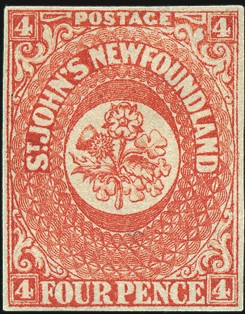
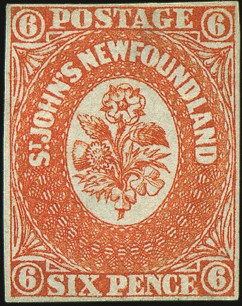
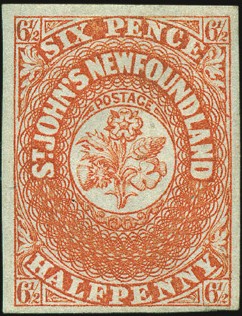
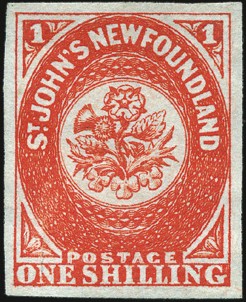
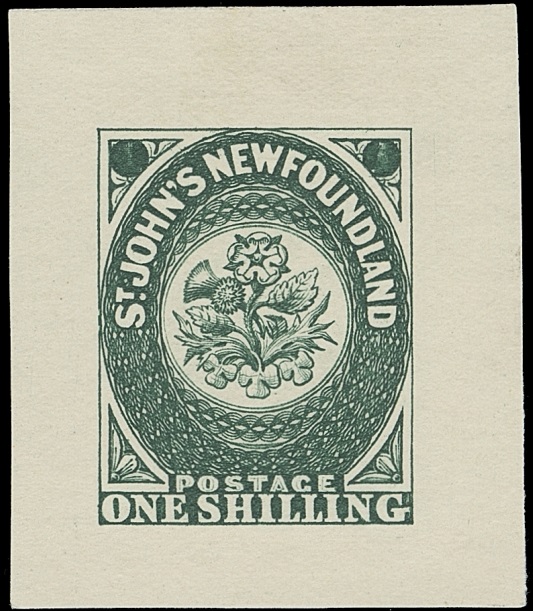
2 p red 4 p red 6 p red 6 1/2 p red 8 p red 1 Sh red
The above red stamps exist in three different colour shaded each: scarlet-vermillion (1857), orange-vermillion (1860) and lake (1861). Many of these stamps were bisected.
Value of the stamps | |||
vc = very common c = common * = not so common ** = uncommon | *** = very uncommon R = rare RR = very rare RRR = extremely rare | ||
| Value | Unused | Used | Remarks |
| Scarlet-vermillion or orange-vermillion colour | |||
| 2 p | RR | RR | |
| 4 p | RRR | RRR | |
| 6 p | RRR | RRR | |
| 6 1/2 p | RRR | RRR | |
| 8 p | RR | RR | |
| 1 Sh | RRR | RRR | |
| Lake colour | |||
| 2 p | R | R | |
| 4 p | ** | *** | |
| 6 p | ** | *** | |
| 6 1/2 p | *** | RR | |
| 8 p | *** | - | Non issued |
| 1 Sh | ** | *** | |
For forgeries of these stamps, click here.
(1866 onwards)
1/2 c red (1887) 1/2 c black (1894)
These stamps are perforated 12.
Value of the stamps | |||
vc = very common c = common * = not so common ** = uncommon | *** = very uncommon R = rare RR = very rare RRR = extremely rare | ||
| Value | Unused | Used | Remarks |
| 1/2 c red | * | * | |
| 1/2 c black | c | c | |
1 c lilac (1868) 1 c lilac (different type) (1870) 1 c lilac (different type) (1880) 1 c green (1887)
The 1 c lilac (1868 issue) exists rouletted.
Value of the stamps | |||
vc = very common c = common * = not so common ** = uncommon | *** = very uncommon R = rare RR = very rare RRR = extremely rare | ||
| Value | Unused | Used | Remarks |
| 1 c lilac | *** | *** | 1868 issue |
| 1 c lilac | *** | *** | 1870 issue |
| 1 c lilac | * | * | |
| 1 c green | * | * | |
Forgeries, example
The above forgery is a Spiro forgery.
2 c green (value in 4 corners) (1866) 2 c green (value in 2 corners) (1880) 2 c orange (1887)
The 1866 issue exists rouletted.
Value of the stamps | |||
vc = very common c = common * = not so common ** = uncommon | *** = very uncommon R = rare RR = very rare RRR = extremely rare | ||
| Value | Unused | Used | Remarks |
| 2 c green | *** | *** | 1866 issue |
| 2 c green | *** | ** | 1880 issue |
| 2 c orange | * | * | |
Forgeries, examples:
Spiro forgery:

(Spiro forgery, easily recognized by the cancel)
The above forgery is a Spiro forgery, it is lithographed (the genuine stamp is engraved). The cancels are typically Spiro cancels (i.e. 6-bar, 4 concentric rings or British colonial type as above). The value circles are solid.
Other forgeries:

The perforation in the above forgeries is very large. Furthermore this forgery is engraved instead of lithographed. There are guidelines in the stamp borders (there are no such lines in the genuine stamps). The eye of the fish is round with a white circle (in the genuine stamps the pupil is mostly coloured).
Moens seems to have made a forgery of this stamp (1866 issue) as well, it can easily be recognized, because it is black instead of green. Futhermore the numerals are larger than in the genuine stamp.
5 c brown (1866) 5 c black (1868) 5 c blue (1876) 5 c blue (1880, different type, no values at the top)
The 5 c blue (1876 issue) only exists rouletted. If perforated, the genuine stamps should be perforated 12.
Value of the stamps | |||
vc = very common c = common * = not so common ** = uncommon | *** = very uncommon R = rare RR = very rare RRR = extremely rare | ||
| Value | Unused | Used | Remarks |
| 5 c brown | RR | R | |
| 5 c black | RR | R | |
| 5 c blue | *** | * | |
| 5 c blue | ** | * | |
Forgeries, examples:
In the above forgery the tail of the seal is not split into two parts. The whole background seems to be filled with icebergs. The label containing 'NEWFOUNDLAND' is sticks out farther to the left and right than the value ovals. There are guidelines in the margins. I've been told that the above forgeries are made by Fournier, but I can't find them in his 1914 pricelist. These forgeries can be found with a cork-cancel, 4 concentric rings, row of oblong dots etc.

(Forgery)
I think the above forgery is a Spiro forgery.
Note the very large perforation in the above forgery, the tail of the seal is also not split.
Other forgeries exist, from Moens (imperforate, left foot has 4 claws, no shading below nose whiskers), Oneglia (?, with perfortation 11 1/2, left foot has 6 claws) and an unkown forger (brown, blue and black, perforated 14 with bottom fram line very faint or absent).

10 c black
Value of the stamps | |||
vc = very common c = common * = not so common ** = uncommon | *** = very uncommon R = rare RR = very rare RRR = extremely rare | ||
| Value | Unused | Used | Remarks |
| 10 c | *** | *** | |
Forgeries, example:
The above forgery is a Spiro forgery (I presume). It is lithographed instead of engraved, perforated 13 (instead of 12).
Another crude forgery (note the strange shape of the 'C' of 'CENTS' for example:
I have also seen the above forgery imperforate.
10 c black (1887) 13 c orange (Schooner, 1866)
Value of the stamps | |||
vc = very common c = common * = not so common ** = uncommon | *** = very uncommon R = rare RR = very rare RRR = extremely rare | ||
| Value | Unused | Used | Remarks |
| 10 c | *** | *** | |
| 13 c | *** | *** | |
Spiro Forgery:

The clouds are very heavyly done. Above the letters 'UN' of 'NEWFOUNDLAND' there should be some dots, which are absent in the above forgery. This is the forgery described in Album Weeds. It is lithographed, instead of engraved for the genuine stamps. There are corner guidelines in these forgeries. The flag behind the ship is larger and more wavy. Of course, the cancel is bogus as with many of the Spiro products.

The above forgery has the word 'NEWFOUNDLAND' quite different, the letters don't touch each other. The '13's are also different. There are guidelines all around the design. The second mast points to the front of the 'W' of 'NEWFOUNDLAND', in the genuine stamps it points to the middle of this letter. The flag behind the ship is smaller than in the genuine stamps. The cancels that can be found on this forgery are quartered corks or four concentric rings. I've been told that this forgery is made by Fournier, however, I can't find it in his 1914 pricelist.
3 c red (1870) 3 c blue (1873) 3 c blue (other design) (1880) 3 c brown (1887) 3 c black (small head of the Queen, 1890) 6 c red (1870, 2 shades of red exist) 12 c brown (1866) 24 c blue (1866) Surcharged on 3 c black (with colour changed)

'ONE CENT' on 3 c blue (3 types 1897)
The 3 c blue (1873 issue) exists rouletted.
Value of the stamps | |||
vc = very common c = common * = not so common ** = uncommon | *** = very uncommon R = rare RR = very rare RRR = extremely rare | ||
| Value | Unused | Used | Remarks |
| 3 c red | *** | *** | |
| 3 c blue | *** | ** | |
| 3 c blue | ** | * | 1880 type |
| 3 c brown | ** | * | |
| 3 c black | * | c | |
| 6 c | * | * | |
| 12 c | ** | ** | New shade of colour was issued in 1894(?) |
| 24 c | ** | ** | |
| Surcharged | |||
| 1 c on 3 c | ** | ** | Cheapest type, other 2 types: *** and RR |
Forgeries, example:
In the 12 c brown the '.' after 'NEWFOUNDLAND' should touch the shading of the 'D' in the genuine stamps. Also the buckle doesn't go into the shaded center in the genuine stamps. Also note the poor expression on the face of the Queen. The outer line of this forgery is double from above the last 'N' of 'NEWFOUNDLAND' to above the end of the 'W' of 'TWELVE'. This is the second forgery described in Album Weeds.

(Spiro forgery of the 12 c?)
Spiro forgeries:

The cancels will condemn these forgeries immediatly; an oval formed by 4 parallel straight lines at top and bottom and 5 curves lines at each side.

(Other forgery of the 24 c value)
For issues of Newfoundland from 1897 to 1920 click here.
Examples:

![]() |
|||||
|
|||||
| Preview of Stamps Catalogue CD : VOLUME 1 |