 |
|||||
|
|||||
| Preview of Stamps Catalogue: VOLUME 2 |
|
|||||
|
|||||
| Preview of Stamps Catalogue: VOLUME 2 |
Lietuva - Litauen - Lithuanie
Return To Catalogue - Central Lithuania
Note: on my website many of the
pictures can not be seen! They are of course present in the catalogue;
contact me if you want to purchase it.
Circles touching each other (4 lines of text,
   Vilnius printing, inscription 'pasta' without final 's')
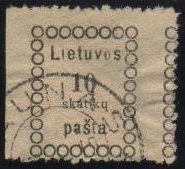

  10 s black
  15 s black
  20 s black
  30 s black
  40 s black
  50 s black
Value of the stamps |
|||
vc = very common c = common * = not so common ** = uncommon |
*** = very uncommon R = rare RR = very rare RRR = extremely rare |
||
| Value | Unused | Used | Remarks |
| 10 s | RR | RR | |
| 15 s | RR | RR | |
| 20 s | *** | *** | |
| 30 s | *** | *** | |
| 40 s | R | R | |
| 50 s | R | *** | |
Circles don't touch each other (4 lines of text, 'skatiku',
  first Kaunas issue, inscription 'pastas' with final 's')
  10 s black
  15 s black
  20 s black
  30 s black
Value of the stamps |
|||
vc = very common c = common * = not so common ** = uncommon |
*** = very uncommon R = rare RR = very rare RRR = extremely rare |
||
| Value | Unused | Used | Remarks |
| 10 s | R | *** | |
| 15 s | R | *** | |
| 20 s | R | *** | |
| 30 s | R | *** | |
3 lines of text, currency 'sk' behind the value
  (second Kaunas issue, inscription 'pastas')
  10 s black
  15 s black
  20 s black
  30 s black
  40 s black
  50 s black
  60 s black
Value of the stamps |
|||
vc = very common c = common * = not so common ** = uncommon |
*** = very uncommon R = rare RR = very rare RRR = extremely rare |
||
| Value | Unused | Used | Remarks |
| 10 s | *** | * | |
| 15 s | *** | * | |
| 20 s | *** | * | |
| 30 s | *** | * | |
| 40 s | *** | * | |
| 50 s | *** | * | |
| 60 s | *** | * | |
3 lines of text, currency ('sk') in front and behind value
  (third Kaunas issue, inscription 'pastas')

(Reduced size)
  10 s black
  15 s black
  20 s black
  30 s black
  40 s black
  50 s black
  60 s black
Value of the stamps |
|||
vc = very common c = common * = not so common ** = uncommon |
*** = very uncommon R = rare RR = very rare RRR = extremely rare |
||
| Value | Unused | Used | Remarks |
| 10 s | *** | * | |
| 15 s | *** | * | |
| 20 s | *** | * | |
| 30 s | *** | * | |
| 40 s | *** | * | |
| 50 s | *** | * | |
| 60 s | *** | * | |
Forgeries exist, by the way, I'm not sure if the above stamps are genuine, example of a forgery:

Deceptive forgeries exist of the first and second Kaunus issue, made by the postmaster of Lithuania (mr. Sruongo). He used the genuine printing plates to make them. They have the cancel '* MARIJAMPOLE * a' in a double circle with date in the center. Genuine stamps with this cancel were never found. Sruongo also made forgeries of other stamps of Lithuania with 'plate errors' and 'perforation errors'. He usually made sure a few of them were actually sold at the post office, such that genuinely used 'errors' existed. He was convicted to a prison sentence for this in 1935.
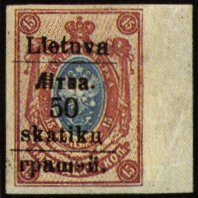
  50 s on 3 k red
  50 s on 5 k lilac
  50 s on 10 k blue
  50 s on 15 k brown and blue
  50 s on 25 k green and violet
  50 s on 35 k brown and green
  50 s on 50 k lilac and green
  50 s on 70 k brown and red

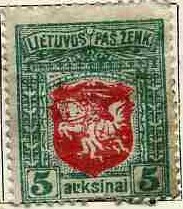
  10 s red (two shades of red were issued)
  15 s violet (two shades)
  20 s blue (two shades)
  30 s orange
  30 s brown
  40 s brown (two shades)
  50 s green (two shades)
  60 s violet and red
  75 s yellow and red (two shades of yellow)
  1 A grey and red (two shades)
  3 A brown and red (two shades)
  5 A green and red (two shades)
Imperforate stamps exist. In 1922 many of these stamps were surcharged:


  '1 CENT.' on 10 s red
  '1 CENT.' on 15 s violet
  '1 CENT.' on 20 s blue
  '1 CENT.' (red) on 20 s blue
  '1 CENT.' on 30 s brown
  '1 CENT.' on 40 s brown
  '1 CENT.' (red) on 40 s brown
  '2 CENT.' on 50 s green
  '2 CENT.' on 60 s violet and red
  '2 CENT.' on 75 s yellow and red
  '3 CENT.' on 1 A grey and red
  '3 CENT.' on 3 A brown and red
  '3 CENT.' on 5 A green and red
  '5 CENT.' (green, vertically) on '4 AUKSINAI' on 75 s yellow and red
  '5 CENT.' (green, vertically) on '4 AUKSINAI' and bars on 75 s yellow and red
  '4 AUKSINAI' on 75 s yellow and red
  '4 AUKSINAI' and bars on 75 s yellow and red
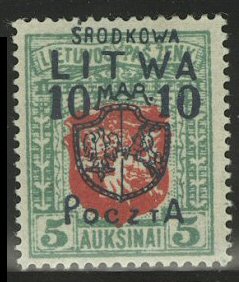
With overprint 'SRODKOWA LITWA Poczta', issued for Central Lithuania
  10 s red
  15 s lilac
  20 s blue
  30 s brown
  40 s brown and green
  50 s red
  60 s lilac
  80 s violet and red
  1 A green and red
  3 A brown and red
  5 A green and red
  10 s red
  15 s blue
  20 s green
  30 s brown
  40 s green and violet
  50 s brown and orange
  60 s red and orange
  80 s grey and red
  1 A black and orange
  3 A black and green
  5 A black and grey
Some very rare proofs(?) (not more than a few thousand exist) were actually used for postage. The colors were different: 20 s green and lilac, 40 s olive, violet and yellow, 50 s brown and violet, 60 s red and green, 80 s green, red and black.
Sower
  10 s red
  15 s violet
  20 s blue
  4 A blue and yellow (1922)
  8 A black and green (1922)

Harvester
  30 s brown
  50 s green (also exists imperforate)
  60 s green and violet

King Keistut
  40 s red
  80 s orange and red
  1 A brown and light green
  2 A blue and red

Man on horse carrying torch
  3 A light brown and blue
  5 A grey and red
  10 A red and lilac
  25 A light brown and green
  100 A red and green (1922)

Surcharged (1922)
  '1 CENT.' on 50 s green (also exists imperforate)
  '3 CENT.' on 10 s red
  '3 CENT.' on 15 s violet
  '3 CENT.' on 20 s blue
  '3 CENT.' on 30 s brown
  '3 CENT.' on 40 s red
  '5 CENT.' on 50 s green
  '5 CENT.' on 60 s green and violet
  '5 CENT.' on 80 s orange and red
  '10 CENTU' on 1 A brown and light green
  '10 CENTU' on 2 A blue and red
  '15 CENTU' on 4 A blue and yellow
  '25 CENT.' on 3 A light bronw and blue
  '25 CENT.' on 5 A grey and red
  '25 CENT.' on 10 A red and lilac
  '30 CENTU' (red) on 8 A black and green
  '50 CENTU' on 25 A light brown and green
  '1 LITAS' on 100 A red and green
  20 s orange and violet
  40 s blue and red
  60 s violet and green
  80 s orange and green
  1 A green and blue
  2 A grey and red
  5 A lilac and blue
Posthorn with wings
  20 s blue
  40 s orange
  60 s green
  80 s red

Other designs
  1 A green and red (aeroplane above road)
  2 A brown and blue (aeroplanes following each other)
  5 A olive and yellow (aeroplane and tower)

Aeroplane above tower (design as 5 A, but smaller)
  2 A blue and red
  4 A brown and red
  10 A black and light blue


Surcharged (1922)
  '10 CENTU' on 20 s blue
  '10 CENTU' on 40 s orange
  '10 CENTU' on 60 s green
  '10 CENTU' on 80 s red
  '20 CENTU' on 1 A green and red
  '20 CENTU' on 2 A brown and blue
  '25 CENT.' on 2 A blue and red
  '30 CENTU' (red) on 4 A brown and red
  '50 CENTU' on 5 A olive and yellow
  '50 CENTU' on 10 A black and light blue
  1 A brown and red
  3 A violet and green
  5 A blue and yellow

Surcharged
  '1 LITAS' on 5 A blue and yellow
  20 s black and red
  40 s green and violet
  50 s lilac and blue
  60 s violet and orange
  1 A red and blue
  2 A blue and brown
  3 A brown and blue
  4 A green and lilac
  5 A brown and red
  6 A blue and light blue
  8 A blue and yellow
  10 A violet and green (3 men on one stamp)
  1 c red, black and green
  2 c black and lilac
  3 c black and yellow
  5 c blue, black and yellow
  10 c black and orange
  15 c black and green
  25 c black and lilac
  30 c black and red
  60 c black and olive
  1 L black and green
  2 L black and red
  3 L black and blue
  5 L black and blue
Village
  2 c brown (1924)
  3 c olive (1924)
  5 c green (1924)
  10 c violet
  15 c red
  20 c brown
  25 c blue
  36 c brown (1924)

Castle
  50 c green
  60 c red

Town
  1 L orange and green
  3 L red and grey
  5 L brown and blue

Overprinted 'KARO NASLAICIAMS' in an arc (different for some values)
and surcharged (charity issue, 1924)
  2 c + 2 c brown
  3 c + 3 c olive
  5 c + 5 c green
  10 c + 10 c violet
  15 c + 15 c red
  20 c + 20 c brown
  25 c + 25 c blue
  34 c + 36 c brown
  50 c + 50 c green
  60 c + 60 c red
  1 L + 1 L orange and green
  2 L + 3 L red and grey
  3 L + 5 L brown and blue

Overprinted 'KARO NASLAICIAMS' in an arc (different for some values)
and surcharged, further surcharged (charity issue, 1926)
  1 c (gold) on 2 c + 2 c brown
  2 c (gold) on 3 c + 3 c olive
  2 c (gold) on 5 c + 5 c green
  5 c (gold) on 10 c + 10 c violet
  5 c (gold) on 15 c + 15 c red
  10 c (gold) on 20 c + 20 c brown
  10 c (gold) on 25 c + 25 c blue
  14 c (gold) on 34 c + 36 c brown
  20 c (gold) on 50 c + 50 c green
  25 c (silver) on 60 c + 60 c red
  30 c (silver) on 1 L + 1 L orange and green

Overprinted 'KARO NASLAICIAMS' in an arc (different for some values)
and surcharged further surcharged with 'VP' and value in gold (charity issue, 1926
  1 c on 2 c + 2 c brown
  2 c on 3 c + 3 c olive
  2 c on 5 c + 5 c green
  5 c on 10 c + 10 c violet
  10 c on 15 c + 15 c red
  15 c on 20 c + 20 c brown
  15 c on 25 c + 25 c blue
  19 c on 34 c + 36 c brown
  25 c on 50 c + 50 c green
  30 c on 60 c + 60 c red
  50 c on 1 L + 1 L orange and green
  2 L + 3 L red and grey
  3 L + 5 L brown and blue
  20 c yellow
  40 c green
  60 c red
  1 L brown

Overprinted 'KARO NASLAICIAMS' in an arc (different for some values)
and surcharged (charity issue, 1924)
  20 c (red) + 20 c yellow
  40 c (green) + 40 c green
  60 c (green) + 60 c red
  1 L + 1 L brown
  20 c red
  40 c violet and red
  60 c blue and black (exists with inverted center)
  2 c orange
  3 c brown
  5 c green
  10 c violet
  15 c red
  25 c blue
  30 c blue (1929)
  15 c red and black
  25 c blue and black
  50 c green and black
  60 c violet and black
  1 L green and grey
  3 L violet and green
  5 L brown and grey
Portrait of Smetona
  5 c brown and green
  10 c violet and black
  15 c orange and brown
  25 c blue and black

Man holding cross
  50 c blue and lilac
  60 c red and black

Man with angel
  1 L brown and dark brown
Image of king
  2 c light brown and dark brown
  3 c brown and violet
  5 c green and orange
  10 c violet and green
  15 c red and violet
  30 c blue and violet
  36 c lilac and black
  50 c green and blue
  60 c blue and red

Larger size (image of knight on horse)
  1 L green, grey and brown
  3 L brown and blue
  5 L brown, grey and orange
  10 L blue, light blue and black
  25 L brown, red brown and grey

Airmail (image of Juozas Tubelis)
  5 c black, olive and yellow
  10 c blue, black and grey
  15 c red, blue and grey

Airmail (woman with sword and aeroplane)
  20 c brown, red and orange
  40 c blue, violet and light blue

Airmail (portraits of two men, aeroplanes above their heads)
  60 c green, black and grey
  1 L red, black and lilac
  5 c blue and yellow
  10 c brown and yellow
  15 c brown and green
  25 c blue and green
  50 c grey and green
  60 c grey and lilac
  1 L blue and grey
  3 L brown and green

Airmail (triangular stamps)
  5 c red and green (map of Lithuania)
  10 c brown and yellow
  15 c blue and yellow
  20 c brown and orange
  40 c brown and yellow
  60 c blue and yellow
  1 L brown and green
  2 L blue and yellow
  5 c red and brown (escape scene, inscription 'VYTAUTAS PASEGA IS KREVES PILIES 1362M.')
  10 c brown and red-brown (design as 5 c)
  15 c lilac and green (conversion, inscription 'VYTAUTAS IR JOGAILA KRIKSTIJA LIETUVA 1386M.')
  25 c brown and light brown (design as 15 c)
  50 c green and red (battle scene)
  60 c green and lilac (design as 50 c)
  1 L blue and grey (meeting of royals at Luzk)
  3 L brown and green (design as 1 L)

Airmail (triangular stamps)
  5 c green and lilac (battle scene, inscription 'MUSIS PRIE SAULES 1236M.')
  10 c green and red (design as 5 c)
  15 c lilac and brown (coronation scene, inscription 'MINDAUGO VAINIKAVIM 1253M.')
  20 c red and violet (design as 15 c)
  40 c brown and black (King with knights)
  60 c orange and black (founding of city by King)
  1 L violet and green (conquering)
  2 L blue and brown (King standing in front of Moscow)
  5 c olive and blue
  10 c violet and brown
  15 c blue and violet
  20 c brown and violet
  40 c blue and violet
  60 c brown and blue
  1 L olive and blue
  2 L violet and green
  5 c green and red
  10 c blue and red
  15 c orange and red
  25 c blue and brown
  50 c olive and blue
  60 c brown and dark brown
  1 L red and brown
  3 L blue and brown
  5 c green and brown (mother and child)
  10 c brown and blue
  15 c green and brown
  25 c orange and black
  50 c green and red
  60 c black and orange
  1 L brown and blue
  23 L violet and green
  5 c red and blue
  10 c violet and green
  15 c green and brown
  20 c lilac and blue
  40 c brown and green
  60 c blue and brown
  1 L olvie and blue
  2 L green and brown
  20 c red and black (portrait of two pilots)
  40 c red and blue (aeroplane above sea)
  60 c violet and black (design as 20 c)
  1 L black and orange (angel standing above crashed aeroplane)
  3 L grey and orange (earoplane above globe)
  5 L brown and light blue (aeroplane with knight and horse on background)

Overprinted 'F.Vaitkus nugaleja Atlanta 21-22. IX 1935' (1936)
  40 c red and blue (RR, not officially issued)
  15 c red
  30 c green
  60 c blue
Arms in shield in upper left corner, value in shield in lower right corner
  2 c red and orange
  2 c orange (slightly smaller size, 1936)
  5 c green and light green
  5 c green (slightly smaller size, 1936)

Three small arms in center, surrounded by ornaments
  10 c brown
  35 c red

Harvesting woman
  25 c brown and green
  50 c blue and light blue

Two women sitting with their back at each other
  1 L brown and lilac
  3 L green and light green

Knight holding sword
  5 L red-brown and light blue
  10 L brown and yellow

Overprinted 'LTSR 1940 VII 21' (1940)
2 c orange
  15 c red
  30 c green
  60 c blue
  15 c red
  30 c green
  60 c blue
I've seen these stamps with overprint 'Memelland ist frei' and swastika; the overprint is in blue on the 15 c, in red on the 30 c and in green on the 60 c:
  5 c + 5 c green
  15 c + 5 c red
  30 c + 10 c blue
  60 c + 15 c brown
This set exists with a boy-scout overprint.
  15 c red (reading the declaration of independence)
  30 c green (president A.Smetona)
  35 c lilac (design as 15 c)
  60 c blue (design as 30 c)

Overprinted 'VILNIUS 1939-X-10' (1939)
  15 c red
  30 c green
  35 c lilac
  60 c blue
  30 c + 15 c black
  15 c + 10 c brown
  60 c + 40 c violet (larger design)
  15 s green (view of Vilnius)
  30 s green (portrait of man, inscription 'GEDIMINAS')
  60 s blue (view of Trakai)
I've seen a souvenir sheet with the above three stamps pasted on it. The inscription reads '1323 1939 URBS VILNIUS METROPOLIS LITHUANIAE RECUPERATA' in gold.
  10 c green
  25 c lilac
  35 c red
  50 c brown
  1 L blue

Overprinted 'LTSR 1940 VII-24'
50 c brown (blue overprint)
  5 c red-brown (knight on horse)
  10 c green (angel with cross)
  15 c orange (woman releasing dove, exists imperforate)
  25 c brown (family)
  30 c blue (bell, exists imperforate)
  35 c red (lion with tree)

Overprinted 'LTSR 1940 VII-24'
  5 c red-brown (blue overprint)
  10 c green (red overprint)
  15 c orange (blue overprint)
  25 c brown (red overprint)
  30 c blue (red overprint)
  35 c red (blue overprint)
Inscription 'Raseiniu Apskricio Pasto zenklas' (1919?):
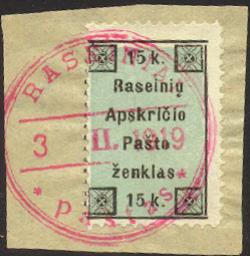
Local issue? 15 k green and black
Inscription 'VALSTYBES RINKLIAVA':
In the above design I have seen: 30 c lilac and red, 50 c brown and red, '1 LITAS' on 10 a blue and red.
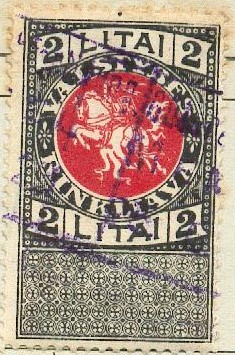
In the above large design I have seen: 2 L black and red, 5 L orange and red. I have also seen a surcharge stamp: '2 LITU' on 100 a blue and red.
Small sized stamps
  2 k green
  5 k red
  10 k blue
  15 k green (soldier)
  20 k green (woman)
  30 k blue (pilot)
  50 k brown (woman)
  60 k red (arms)

Larger size (with larger overprint)
  80 k blue
Stamps of the Sowjet Union, overprinted 'Laisvi Telsiai 1941. VI. 26.'

http://members.fortunecity.com/jtckaptein/philatelyoflithuania/onaeng.htm
In 1920 the Memel territory (formerly belonging to Germany) was put under the influence of France. It joined Lithuania in 1923. For examples of these stamps see Cd 1.
